

Private Limited vs LLP: Which is the Best for Startups
Starting a business in 2026 is exciting, but the wrong structure can quietly cost you growth, funding, and even control of your own company. Many founders register their business in a rush without understanding that Private Limited and LLP are designed with entirely different objectives.
Here’s the reality: The choice you make today will decide how easy it is to raise money, how much compliance you handle, and how fast you grow tomorrow.
So, which actually gives your startup an advantage in 2026, Private Limited or LLP?
Let’s divide it in such a way that even a fool can understand, so you can make the best decision in the early days.
What is a Private Limited Company?
One of the highly recommended and preferred business structures in India for a businessman to start with for long-term business growth and business scalability is a Private Limited Company (Pvt Ltd Company). It is applicable under the Companies Act 2013 and provides an organised way of running a business in a legal manner. Many founders also hire Pvt Ltd company registration professionals to simplify the incorporation process and avoid compliance-related errors during the early stages of business setup.
A Private Limited Company (Pvt Ltd Company) is a separate legal entity, which means it has its own identity which is separate from its owners. It may hold property, make contracts, and sue and be sued in its own name. This provides a limited liability shield, where the personal assets of shareholders are protected from business debts and risk.
To put it simply, a private limited company allows you to carry out business in a way where owners (shareholders) and the management (directors) are considered separate, leading to better governance and control.
Furthermore, a private limited company has greater credibility, which helps in raising funds from investors, banks and venture capitalists. It also enjoys perpetual succession, which means even with a change in ownership or management, the company will continue to exist.
Key Features of a Private Limited Company

- Separate Legal Entity: The company can have its property and affairs, sue and be sued, etc., in its own name.
- Limited Liability: Shareholders are liable only to the extent of their share capital – your personal assets remain protected.
- Ownership via Shares: The company is owned by the shareholders, and shares can be transferred with ease.
- Perpetual Succession: The company remains in existence even if the owners or directors are changed.
Best Suited For
- A startup that is going to raise money from investors or venture capitalists
- Businesses looking to grow and scale quickly
- Founders looking to establish a strong and credible brand presence
What is an LLP (Limited Liability Partnership)?
LLP (Limited Liability Partnership) is a mixed type of business structure which has the features of a traditional partnership and the advantages of a company regarding legal protection. It is governed by the Limited Liability Partnership Act, 2008, and it is a body corporate, which is required to have at least two partners. The liability of the partners is limited to the extent of their contribution in the LLP and their personal pr...
As an LLP is a separate legal entity, it can hold property, make contracts, sue or be sued and carry on business or activities in its own name, separate from its partners. This quality allows an LLP to take over the business during a change of partners or a partner’s death, and it is said to have perpetual succession.
Unlike a company, an LLP has no minimum capital requirement, which provides more flexibility to the startups and the founders. Also, its burden of compliance is on the lighter side with compulsory filing of e. g., from 11 (annual return) and 8 (statement of account and solvency)
Key Features of LLP

- Separate Legal Entity: An LLP is capable of holding property, entering into contracts, and conducting business in its own name.
- Limited Liability: The liability of a partner is limited to the extent of his agreed contribution.
- Flexible Management: The partners may have direct management of the business without complicated structures.
- Less Compliance: Less legal formalities than a Private Limited company.
Best Suited For
- Small-scale and startups with a small investment requirement
- Professionals such as CAs, Lawyers, Consultants, and Freelancers
- Business owners seeking low-cost and simple ownership options.
Private Limited vs LLP: Key Differences
The decision between a Private Limited Company and an LLP is made easy when you get a comparative view in tabular form. Here's a straightforward 2026 rundown based on the factors that really matter for startups:
Benefits of Choosing LLP for Your Startup
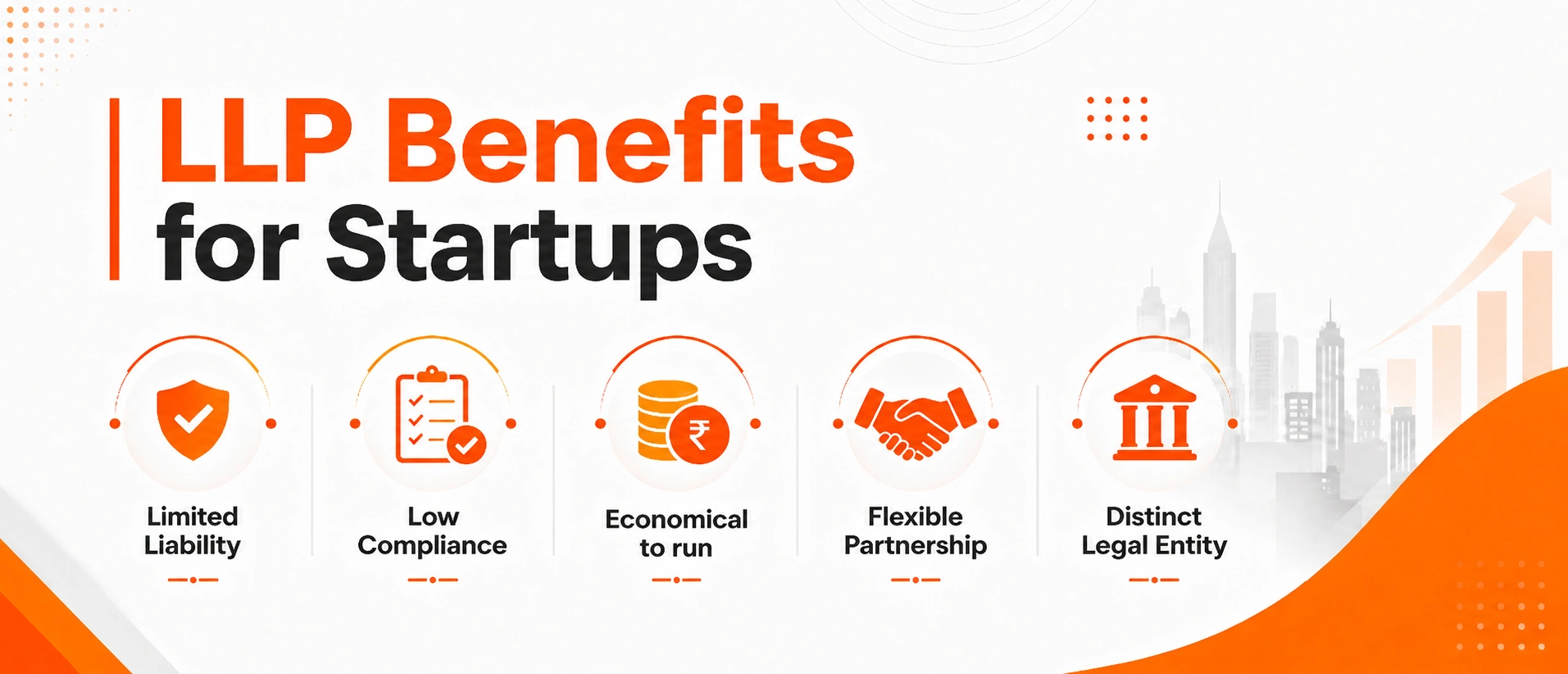
The Limited Liability Partnership (LLP) has emerged as a preferred business entity among many startups in India, especially in service-based, bootstrapped businesses. It has the flexibility of a partnership, but also provides limited liability protection.
- Protection against Liability: The liability of partners in an LLP is limited (to the extent of their agreed contribution), and they are not personally liable for the debts of the business.
- Lower Compliance Burden: In terms of compliance burden, LLPs have fewer than that of a Private Limited Company.
- Economical to run: LLPs are generally cheaper to run
- Flexible Partnership Arrangement: The partners wholly own the business and can run it with straightforward control in a limited liability partnership (LLP).
- Distinct Legal Entity: An LLP is a separate legal entity from its partners.
Benefits of Choosing a Private Limited Company for Your Startups
A Private Limited Company (Pvt Ltd) is one of the most preferred business structures for startups in India. From fundraising opportunities to brand credibility, this structure offers several advantages for businesses planning long-term growth.
- Simple Fundraising Methods: The ease of raising funds is one of the greatest benefits of the Private Limited Company.
- Protection of Liability: Shareholders have limited liability in a Private Limited Company.
- Distinct Legal Identity: A Pte Ltd company is a separate legal entity from its owners.
- Enhanced Startup Credibility: “Private Limited” in your business name lends stronger trust in the market.
- Seamless Transfer of Ownership: A share in a private limited company can be easily transferred among shareholders.
Conclusion
Deciding between a Private Limited Company vs LLP is not just a matter of law but a strategy that would define the future of your startup. If you want to raise money, grow fast, and build a strong brand, a Private Limited Company comes out easily as the winner. However, if you want low cost, minimum compliance, and operational flexibility, an LLP is the smartest and most sensible option.
For a lot of business owners, the thought of dealing with registrations, compliance, and legal formalities is daunting. From planning and construction through legal and regulatory compliance, companies like Arvian Business Solutions Pvt. With virtual office services, nationwide support, and more, these teams empower small business owners to focus on growth and take the hassle out of the back office, without complicating the process.